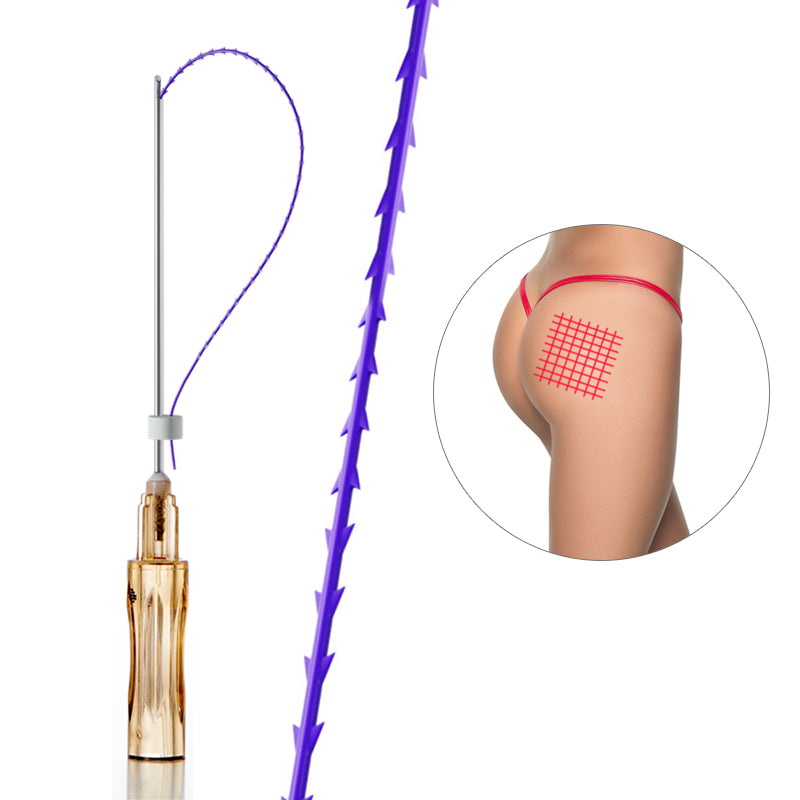
Auro PDO Fishbone Cog Threads 18G 19G L Cannula Maximum Tensile Tissue Anchor Lift
Auro PDO Fishbone Cog Threads 18G 19G L Cannula Maximum Tensile Tissue Anchor Lift
Couldn't load pickup availability
Auro PDO Fishbone Cog Threads — Biomimetic High-Tensile Anti-Slippage Tissue Suspension
Auro PDO Fishbone Cog Threads are premium absorbable polydioxanone structural lifting sutures engineered with a biomimetic staggered herringbone (fishbone) barb architecture. Designed specifically for high-load anatomical suspension, the symmetrical opposed-barb design creates an interlocking mechanical anchor in fibrous subcutaneous tissue, delivering superior pullout resistance and preventing the retrograde thread slippage common in traditional linear cogs.
- Primary Function: Heavy-duty tissue elevation, lower-face jowl restoration, mandibular border sharpening, and submental suspension
- Biomimetic Architecture: Symmetrical staggered fishbone barbs with rounded base cuts to preserve core tensile integrity
- Needle Delivery System: High-flow atraumatic L-Cannula (18G / 19G) for vascular-safe glide through dense facial planes
- Absorption Profile: 100% hydrolyzed via natural biological breakdown over 6–8 months; reinforced collagen anchor lasts up to 12–18 months
- Suture Sizes: USP 2 heavy-duty high-tensile barbed filament
- Packaging: Sealed in sterile medical-grade blister foil pouches
Treatment Area & Protocol Selection Guide
The high-anchor Fishbone geometry is specifically indicated for anatomical vectors carrying significant tissue mass or gravitational descent:
- Lower Face Jowls & Mandibular Border: 18G or 19G 100mm (L-Cannula) (Recommended: 3–5 threads per side) — Anchors heavy descended fat pads along the jawline to re-establish a crisp, defined profile.
- Mid-Face & Malar Fat Pad Elevation: 19G 100mm (L-Cannula) (Recommended: 3–4 threads per side) — Repositions dropped cheek volume upward and obliquely, softening deep nasolabial folds.
- Submental Tightening & Double Chin: 19G 100mm (L-Cannula) (Recommended: 2–4 threads) — Creates an interlocking submandibular sling to eliminate under-chin skin redundancy.
- Heavy / Fibrous Facial Profiles & Male Patients: 18G 100mm (L-Cannula) (Recommended: 4–6 threads per side) — Delivers the maximum mechanical traction required for dense, fibrous skin without barb flattening.
- Lateral Cheek & Pre-Auricular Lift: 19G 100mm (L-Cannula) (Recommended: 2–3 threads per side) — Smooths accordion smile lines and tightens lateral cheek laxity toward the temporal anchor.

Quality, Safety & Sterility Assurance
- CE Certified Medical Device: Manufactured under strict international medical standards for verified tensile holding force and clinical safety.
- 100% EO Gas Sterilized: Every individual blister pack undergoes medical-grade Ethylene Oxide (EO) sterilization, ensuring zero contamination.
- 2-Year Sterile Shelf Life: Every pack is clearly stamped with a dedicated LOT number, production date, and 2-year expiration date.
- Protective Medical Aluminum Foil: Double-sealed sterile pouches prevent polymer degradation from ambient humidity, UV light, and heat during international transit.
- Biocompatible & Non-Pyrogenic: Ultra-pure absorbable suture polymer that fully hydrolyzes into water and carbon dioxide with zero residue, granuloma, or pigment accumulation.
FAQ
Q1: What makes the Fishbone barb design mechanically superior to standard cutting cog threads?
A: Standard cutting cogs slice deep notches into the thread core, which can weaken the central tensile strength at every cut point and cause barbs to fold flat under high tension. Fishbone threads utilize a specialized rounded-root notch and staggered opposed barb angle. This geometry distributes mechanical load across a wider base, preventing barb collapse and providing up to 2x higher pullout resistance against gravitational tissue descent.
Q2: Why is the L-Cannula delivery system preferred for Fishbone threads?
A: The L-Cannula features a smooth, rounded blunt tip with a lateral extrusion port. When advancing through dense subcutaneous fat, the blunt tip pushes blood vessels and facial nerve branches aside rather than severing them. This virtually eliminates hematoma and nerve irritation, allowing practitioners to position heavy 18G/19G fishbone threads safely with minimal post-procedure bruising.
Q3: When should I choose 18G versus 19G Fishbone threads?
A:
• 18G (Maximum Structural Load): Thicker suture core with deepest anchor holding force. Indicated for heavy tissue mass, severe lower-face sagging, thick male skin, or revision lifting cases.
• 19G (Versatile Clinical Standard): Ideal balance of strong mechanical suspension and smooth cannula passage. Indicated for standard mid-face elevation, moderate jowls, and defined jawline sculpting.
Q4: How should post-procedure care be managed to prevent barb disengagement?
A: Because Fishbone barbs create a strong physical interlock with surrounding fibrous tissue, it takes 10 to 14 days for the initial inflammatory fixation and collagen anchoring to fully mature. Patients should avoid wide mouth opening, hard or chewy foods, facial massages, strenuous workouts, and sleeping on their sides for 2 weeks post-procedure.
Q5: Can Fishbone threads be layered with other thread types in a comprehensive protocol?
A: Yes. Fishbone threads serve as the primary structural pillars to hoist and anchor heavy fallen tissue. Once the foundation is elevated, practitioners frequently insert Auro Mono or Screw threads into superficial layers to refine fine texture, or use Auro Nose threads for central facial balance.