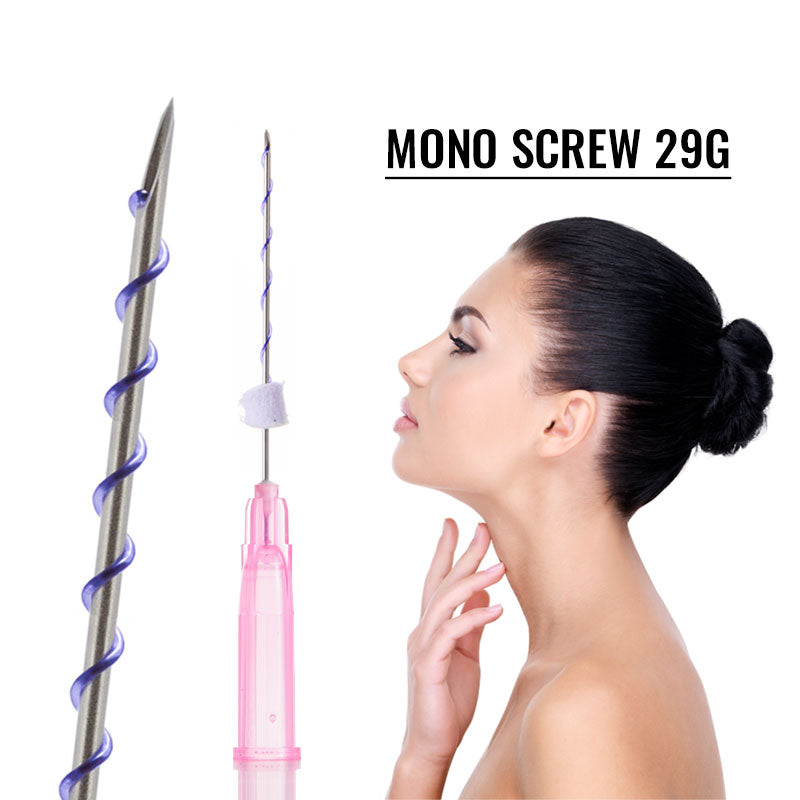
Auro PDO Mono Screw Threads Sharp Needle 26G to 30G Wrinkle Smoothing Collagen Boost
Auro PDO Mono Screw Threads Sharp Needle 26G to 30G Wrinkle Smoothing Collagen Boost
Couldn't load pickup availability
Engineered for Amplified Collagen Response — The Auro PDO Mono Screw Thread
The Auro PDO Mono Screw Thread is a helical-wound, smooth absorbable thread engineered to maximize collagen induction per insertion. Unlike a straight mono thread, the screw configuration dramatically increases the effective surface area of PDO in contact with dermal tissue — generating a stronger fibroblast activation signal from a single needle pass.
The result is measurably greater collagen density per treatment zone, with the same minimal-trauma profile and full absorbability characteristic of medical-grade PDO. For practitioners designing collagen induction protocols that demand higher stimulus intensity without increasing insertion count, the Mono Screw is the precision tool of choice.
The Screw Mechanism: Why Geometry Changes Performance
A standard smooth mono thread delivers collagen stimulus along a linear path. The Mono Screw thread is wound into a continuous helix around the insertion needle — when the needle is withdrawn, the coil remains implanted in the tissue, occupying a three-dimensional column rather than a single line.
This structural difference produces three compounding effects:
- Greater surface-area-to-volume ratio: The helical winding creates significantly more PDO surface contact per millimeter of tissue depth compared to a linear thread, intensifying the foreign-body response that drives fibroblast recruitment
- Volumetric collagen scaffold: The coil structure physically occupies a tubular column within the dermis, providing a three-dimensional scaffold around which new collagen is synthesized — producing denser, more uniform results across the treatment volume
- Enhanced mechanical anchoring during absorption: As the PDO degrades over 6–8 months, the coil geometry maintains spatial distribution of the stimulus across the column, sustaining fibroblast activity longer than a degrading linear thread
Clinical Indications: Where the Mono Screw Outperforms the Straight Mono
| Treatment Goal | Why Mono Screw Is the Preferred Choice |
|---|---|
| Significant skin laxity without tissue descent | Requires higher collagen density than a straight mono can efficiently deliver — the screw achieves this with fewer insertions |
| Skin thickness restoration (atrophic or aged dermis) | The volumetric scaffold structure actively rebuilds dermal matrix in depleted tissue, not just stimulates the surface layer |
| Deep nasolabial fold softening | Cross-hatch screw placement in the mid-to-deep dermis delivers the collagen volume needed to mechanically soften deeper folds |
| Neck rejuvenation (horizontal lines + diffuse laxity) | The coil's sustained stimulus across a tissue column is particularly effective for the thinner, more fragile neck dermis requiring consistent, distributed collagen induction |
| Body skin tightening (abdomen, inner arms, inner thighs) | Large-area body applications benefit from the screw's higher stimulus-per-insertion efficiency — fewer needle passes for equivalent collagen response compared to straight mono |
| High-definition facial contouring (jawline, mid-face) | Precise screw placement in targeted zones creates localized collagen density that refines contour definition without mechanical tissue movement |
Protocol Design Principles
Single-gauge protocols: For practitioners standardizing on a single screw gauge per treatment area, 27G 38mm covers the broadest range of mid-facial indications with predictable mid-dermal placement depth. For body treatments, 26G 60mm or 26G 90mm delivers maximum stimulus efficiency per insertion.
Dual-layer screw protocols: Advanced practitioners pair a superficial screw (30G 38mm) with a mid-dermal screw (27G 50mm) in the same zone — creating a stacked collagen scaffold that addresses both dermal layers simultaneously. This approach is particularly effective for moderate-to-significant facial laxity where a single layer of stimulation produces insufficient collagen density.
Screw + straight mono combination: The Mono Screw can be deployed alongside Auro PDO Smooth Mono threads within the same treatment session. The straight mono provides high-density superficial mesh coverage; the screw provides deep-column volumetric stimulus. Together they deliver a full-spectrum collagen induction protocol from surface to deep dermis.
Material, Sterilization, and Regulatory Specifications
- Material: Medical-grade Polydioxanone (PDO) — ISO 10993 biocompatibility certified; same polymer class as Class III absorbable surgical sutures with decades of clinical safety data
- Thread construction: Continuous helical winding on insertion needle; coil is pre-formed to retain geometry upon implantation and during the full absorption cycle
- Absorption timeline: Complete hydrolytic degradation in 6–8 months; metabolized to CO₂ and H₂O — no residual material, no extraction required
- Sterilization method: Ethylene oxide (EtO) double-cycle sterilization to sterility assurance level (SAL) 10⁻⁶
- Packaging: Individual hermetic blister pack; single-use only

FAQ
Q1: What is the mechanical difference between a Mono Screw thread and a standard straight Mono thread — and when should I choose one over the other?
A: The fundamental difference is geometry. A straight mono thread delivers collagen stimulus along a single linear axis — effective for high-density superficial mesh work where insertion count is high and per-insertion stimulus doesn't need to be maximized. The Mono Screw thread is wound into a continuous helix: when implanted, it occupies a three-dimensional tissue column rather than a line, creating greater PDO surface contact per insertion and a correspondingly stronger fibroblast response. Choose straight mono when you need fine-mesh density over large surface areas with minimal per-insertion trauma. Choose Mono Screw when you need higher collagen stimulus intensity per needle pass — for moderate laxity, thicker dermal zones, deep nasolabial work, or any case where increasing insertion count isn't the preferred approach to increasing collagen output.
Q2: Does the screw geometry affect insertion technique compared to a straight mono thread?
A: Yes, with one key distinction. With a straight mono thread, the standard retrograde withdrawal technique is used. With a Mono Screw, the needle is inserted to target depth using the same approach, but withdrawal should be smooth and deliberate — rapid withdrawal can partially straighten the coil before it anchors in the tissue. Some practitioners prefer a slight rotational component on withdrawal to help seat the coil. The coil is pre-formed and will retain its helical geometry once the needle clears the tissue, but technique consistency on withdrawal significantly affects final scaffold geometry.
Q3: Can Mono Screw threads be used in the same session as PDO Cog (barbed lifting) threads?
A: Yes, and this combination is a recognized advanced protocol. Cog threads mechanically reposition descended tissue and create the structural framework; Mono Screw threads placed in the same or adjacent zones stimulate collagen production to reinforce and sustain the repositioning effect. The typical sequencing is cog placement first to establish the lift vector, followed by screw implantation in the surrounding tissue for collagen support. This approach is particularly effective for cases presenting simultaneous tissue descent and significant collagen depletion.
Q4: What is the expected collagen remodeling timeline for Mono Screw threads?
A: The timeline follows the same biological sequence as all PDO collagen induction: initial fibroblast recruitment begins within days of implantation; early collagen synthesis is detectable at 4–6 weeks; peak collagen density is reached at approximately 3 months as the thread completes the bulk of its degradation; results are maintained for 12–18 months as the new collagen matrix matures. Due to the higher stimulus intensity of the screw geometry, some practitioners observe earlier visible improvement onset (3–5 weeks) compared to straight mono protocols in the same patient, though individual response varies with skin condition, age, and treatment zone.