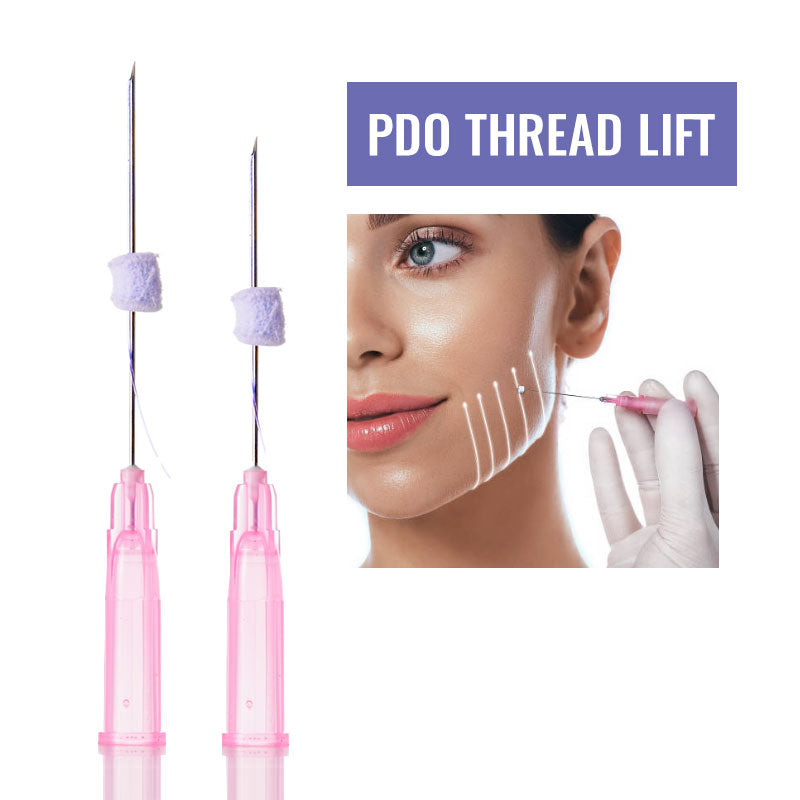
Auro PDO Mono Thread for Skin Tightening and Collagen Stimulation
Auro PDO Mono Thread for Skin Tightening and Collagen Stimulation
Couldn't load pickup availability
What Is a PDO Smooth Mono Thread — and What Does It Actually Do?
A PDO Mono Thread is a ultra-fine, fully absorbable filament. Unlike barbed lifting threads, it does not mechanically reposition tissue. Its function is biological: once implanted into the skin, it signals your skin cells to rebuild collagen.
The thread triggers fibroblasts — the cells responsible for collagen synthesis — to migrate to the implant site and produce new collagen around the filament. As the PDO dissolves over 6–8 months, the collagen it generated remains, progressively improving skin elasticity, thickness, and texture. Results typically begin to appear at 4–8 weeks, stabilize at 3 months, and last 12–18 months.
This product is designed for:
- Skin that has begun to thin, losing the firmness it once had
- Fine lines and surface texture that topical skincare can no longer improve
- Overall dullness, uneven tone, or loss of radiance
- Preventive collagen maintenance — before visible aging accelerates
Treatment Areas and Expected Results
| Area | Expected Improvement |
|---|---|
| Periocular (crow's feet, under-eye fine lines) | Reduced surface lines, improved skin thickness and brightness under the eye |
| Forehead horizontal lines | Shallower lines as dermal thickness increases and collagen density improves |
| Perioral (lip lines, mild nasolabial area) | Smoother lip border, reduced fine lines around the mouth |
| Cheeks (skin quality, mild laxity) | Improved collagen density and skin tone — visually firmer and more luminous |
| Neck (horizontal lines, overall laxity) | Smoother neck skin, reduced horizontal bands, improved contour definition |
| Body (abdomen, inner arm, décolletage) | Improved skin texture and mild laxity over larger surface areas |
How to Choose the Right Specification
Two variables: gauge (G) and length (mm). Higher G number = finer needle and thread. Longer length = greater tissue coverage per insertion.
| Specification | Thread Gauge | Best-Suited Areas | When to Use |
|---|---|---|---|
| 30G 13mm | Finest, shortest | Crow's feet, perioral fine lines | Sensitive zones requiring precise, localized placement |
| 30G 25mm | Finest, short | Under-eye, lip border, single forehead lines | Delicate areas needing slightly broader shallow coverage |
| 30G 38mm | Finest, mid-length | Forehead, superficial cheek layer, perioral | Most widely used spec for facial superficial collagen mesh |
| 27G 38mm | Medium-fine, mid-length | Mid-cheek layer, mandibular edge skin | Cheek zones requiring stronger collagen stimulus |
| 29G 38mm | Fine, mid-length | Neck horizontal lines, jawline edge | Neck or thinner skin areas — balanced safety and efficacy |
| 29G 50mm | Fine, longer | Full neck, lower mid-face | Broader coverage where skin is finer |
| 26G 60mm | Medium, long | Deep cheek layer, neck, body | Stronger collagen stimulus and large-area coverage |
| 26G 90mm | Medium, longest | Full neck, abdomen, inner arm | Body applications and full-neck protocols |
Not sure which to choose? The most common facial combination is 30G 38mm (superficial layer) paired with 26G 60mm (deeper layer) — together they build a two-level collagen architecture that outperforms either specification used alone.
Safety
- Fully absorbable: Naturally metabolized by the body within 6–8 months into CO₂ and water — no removal required, no residual material
- No mechanical tension: Smooth threads do not pull or displace tissue, eliminating the risk of migration — suitable for long-term maintenance protocols
- Minimal downtime: Injection points may show slight redness, typically resolving within 24–48 hours — no interruption to daily activity
- Medical-grade sterilization: Each thread is ethylene oxide double-cycle sterilized, individually hermetic blister-sealed, single-use

FAQ
Q1: What is the difference between PDO Mono threads and lifting (cog) threads — and how do I know which one I need?
A: They solve different problems. Lifting threads (Cog/Molding series) have barbs that physically anchor and reposition descended tissue — they are the right choice when facial volume and contour have visibly dropped. Smooth Mono threads have no barbs and cannot reposition tissue, but they trigger the skin's own collagen production to improve elasticity, thickness, and surface texture — something barbed threads cannot do. The deciding factor: if your primary concern is thinning skin, fine lines, and loss of radiance, Mono threads are the correct approach. If the concern is facial descent — a blurred jawline, sagging cheeks, or dropped brow — lifting threads are needed. Both can be combined in the same treatment session when both issues are present.
Q2: How many threads are needed per treatment, and how long do results last?
A: Thread count depends on the area being treated. A single facial zone (such as the periocular or forehead area) typically requires 10–20 threads. A full-face mesh protocol uses 30–60 threads. A full-neck treatment typically requires 15–25 threads. Results begin to appear at 4–8 weeks as collagen synthesis ramps up, reach their peak at approximately 3 months, and are maintained for 12–18 months. A maintenance session at 6–12 months after the initial treatment allows results to compound over time.
Q3: Will the threads be noticeable after insertion — can they be felt or seen?
A: In the vast majority of cases, threads are not felt after the procedure. The finest specification (30G) has an outer diameter of approximately 0.30mm and has no barbed structure, so there is no pulling sensation. Injection points may show minor redness or localized swelling for 24–48 hours. Results develop gradually — patients do not look visibly altered, facial movement is completely unaffected, and there is no sudden or dramatic change in appearance.
Q4: Is this a one-time treatment or does it need to be repeated?
A: Results from a single session naturally diminish over 12–18 months as the body's own collagen continues to break down with age. Most patients choose a maintenance session approximately every 12 months. Each subsequent treatment builds on the collagen foundation established by the previous one — patients who maintain a consistent schedule typically sustain skin quality improvement significantly longer than those who treat once and wait.
Q5: Does this need to be performed by a medical professional?
A: Yes. PDO thread procedures must be performed by a licensed aesthetic medical practitioner in a professional clinical environment. Correct insertion depth, sterile technique, and anatomical knowledge are essential for both safety and outcomes. This product is supplied for use by qualified practitioners.