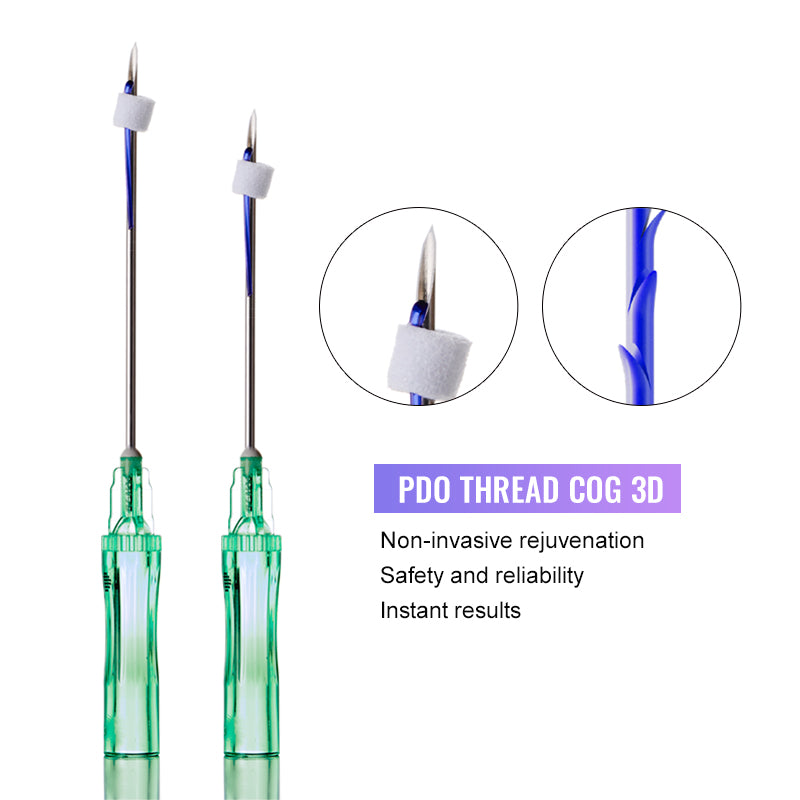
Auro PDO Cog 3D Thread Face Cheek Eyebrow Lift
Auro PDO Cog 3D Thread Face Cheek Eyebrow Lift
Couldn't load pickup availability
Auro PDO Cog 3D Thread
The Cog 3D uses a three-row barb configuration — the most precisely targeted barb geometry in the Auro PDO cog range. Three rows mean a tighter, more compact anchoring footprint compared to four- or six-row designs, which translates to two practical advantages: the insertion corridor is narrower, and the lifting vector is more directional. This makes the Cog 3D the right choice when the treatment objective is localized, single-zone repositioning rather than broad-area structural lifting.
The thread is available in two needle types — Sharp (S) and Long blunt cannula (L) — covering distinctly different insertion techniques and anatomical zones across three gauge options.
Needle Type Comparison
| Type | Needle | Insertion Method | Best Used For |
|---|---|---|---|
| Cog 3D S (Sharp) | Sharp needle | Direct skin penetration, no pre-puncture needed | Small-zone precision lifting: eyebrow tail, lateral canthus, perioral, fine facial contouring |
| Cog 3D L (Long blunt cannula) | Blunt cannula | Entry via small puncture, then tissue tunneling | Mid-face zones, cheek, jawline — areas where neurovascular structures require atraumatic navigation |
Full Specification Range
| Configuration | Gauge | Length | Target Depth | Primary Application |
|---|---|---|---|---|
| Cog 3D S | 23G | 60mm | Superficial to mid-dermis | Eyebrow tail lift, lateral eye area, perioral fine lines — high-precision, small-zone |
| Cog 3D S | 23G | 90mm | Mid-dermis to subcutaneous | Extended periorbital vector, temple zone, upper cheek contouring |
| Cog 3D S | 19G | 100mm | Subcutaneous | Cheek repositioning, nasolabial fold axis — higher load capacity with sharp entry |
| Cog 3D L | 19G | 100mm | Subcutaneous | Mid-face, jawline sweep — atraumatic delivery in vascular zones |
| Cog 3D L | 21G | 60mm | Mid subcutaneous | Focused cheek lift, malar zone, short-vector facial contouring |
| Cog 3D L | 21G | 100mm | Subcutaneous | Full cheek-to-jawline vector, nasolabial correction, lower face repositioning |
How the 3D Barb Geometry Works
Three barb rows are distributed at equal angular spacing around the thread core. Compared to higher-row configurations, the three-row design concentrates anchoring force along a narrower circumferential arc. In practical terms, this means:
- More directional vector control: The lift force is less dispersed, making it easier to direct the thread along a precise anatomical axis — useful in small zones like the brow or lateral cheek where millimeter-level placement accuracy matters
- Smaller insertion footprint: The narrower barb deployment profile allows the thread to be placed in tighter anatomical corridors without disturbing adjacent tissue planes
- Collagen stimulation along the full insertion path: As with all PDO cog threads, the barb surfaces trigger fibroblast recruitment around the thread axis, producing a collagen matrix that maintains tissue position after the PDO resorbs at 6–8 months
Sharp vs. Blunt: When Each Is Appropriate
The choice between S-type and L-type is determined by anatomy, not preference. Sharp needles penetrate skin directly and are suitable when the insertion path is short, the target depth is mid-dermal, and the anatomical zone does not contain significant neurovascular structures in the insertion corridor. Blunt cannulas require a small entry puncture but navigate tissue by displacement rather than cutting — making them the appropriate choice when the thread needs to cross neurovascular zones, as in mid-face, lower face, and neck trajectories. The 23G S-type is specifically suited for the periorbital and perioral zones where fine-gauge sharp-needle work gives the practitioner the most control over depth and vector.
Manufacturing Standards
- Medical-grade PDO (Polydioxanone), ISO 10993-compliant
- CNC-precision barb cutting — consistent angle, depth, and spacing across all three rows
- Double-cycle EtO sterilization, SAL 10⁻⁶, non-pyrogenic certified
- Individually hermetic blister-sealed packaging
- Full PDO resorption at 180–240 days; collagen result duration 12–18 months

FAQ
Q1: What is the clinical case for a three-row (3D) cog thread when four-row and six-row options exist?
A: The number of barb rows determines the width of the anchoring arc and how broadly the lift force is distributed. Four-row and six-row configurations spread anchoring across a wider circumferential area, which is advantageous for large-zone lifting where omnidirectional grip is needed. The three-row design concentrates anchoring into a narrower arc, producing a more focused, directional lift vector. This is the correct choice when the treatment objective is single-zone precision repositioning — eyebrow tail elevation, lateral cheek definition, perioral support — where a tighter vector is more useful than a broader structural lift. Think of it as the difference between a wide-area anchor and a targeted directional pull.
Q2: When does gauge selection (19G vs. 21G vs. 23G) affect the clinical outcome?
A: Gauge affects two variables: the diameter of the tissue tunnel and the physical barb size. The 19G creates a wider tunnel and carries larger barbs, generating more anchoring surface area per unit length — appropriate for zones that require higher load-bearing capacity, such as the cheek-to-jawline axis in patients with moderate laxity. The 21G is the mid-range option, balancing holding strength with a smaller insertion footprint — suited to standard mid-face and cheek applications. The 23G creates the finest tunnel, with minimal tissue disruption and very precise placement control — the correct choice for the periorbital area, eyebrow, and perioral zones where adjacent tissue sensitivity is high and barb-level precision matters more than maximum holding force.
Q3: How does the sharp-needle S-type compare to a standard mono sharp thread in terms of technique?
A: The insertion technique is similar — direct skin penetration, no pre-puncture required. The difference is what happens after insertion. A mono sharp thread is a straight filament that stimulates collagen along a linear path with no mechanical lift. The Cog 3D S has barbs that engage surrounding tissue as the thread is partially withdrawn, creating a mechanical lift vector at the same time as initiating the bio-stimulation response. The S-type is the option when the practitioner wants the simplicity of sharp-needle direct insertion combined with the anchoring and lifting function of a cog thread, particularly in fine-anatomy zones where blunt cannula navigation would be unnecessarily complex.
Q4: Can Cog 3D threads be used alongside other thread types in the same session?
A: Yes. A common protocol structure is to use larger cog threads (4D or 6D, or Fishbone) for broad structural repositioning across the mid-face and lower face first, then use Cog 3D threads for secondary zone-specific refinement — brow elevation, lateral cheek definition, perioral support — where the broader threads do not reach or where a more precise vector is needed. Place broader structural threads first, then Cog 3D threads second. This sequencing avoids disturbing 3D thread placement when inserting the larger structural threads.
Q5: What post-procedure considerations are specific to the 23G S-type sharp needle configuration?
A: Because the 23G sharp needle penetrates skin directly without pre-puncture, entry point management is straightforward — the fine gauge leaves a minimal insertion mark that resolves within 24–72 hours in most patients. The narrow 23G barb profile also means lower immediate post-procedure swelling compared to wider-gauge insertions. In the periorbital zone specifically, practitioners should account for the relative thinness of the skin and confirm insertion depth remains within the subcutaneous plane above the orbicularis oculi. As with all sharp-needle cog work, slow, controlled retrograde withdrawal is required to ensure uniform barb engagement along the full thread length.