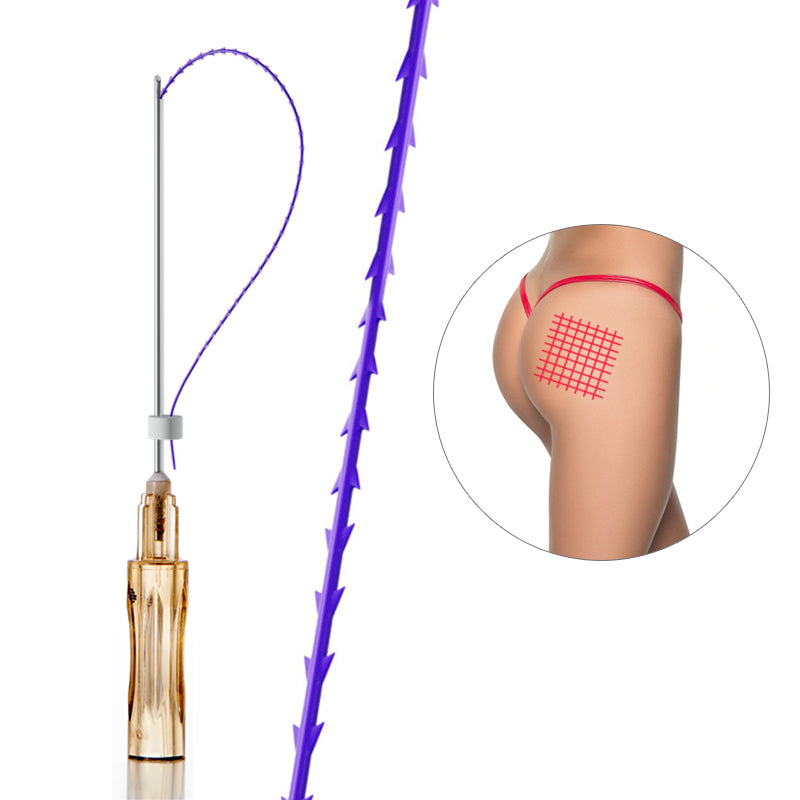
Auro PDO Fishbone Cog Threads Long- Lasting Skin Tightening
Auro PDO Fishbone Cog Threads Long- Lasting Skin Tightening
Couldn't load pickup availability
Auro PDO Fishbone Cog Thread — Symmetrical Dual-Plane Barb Engineering for High-Load Facial Lifting
The Auro PDO Fishbone Cog Thread is engineered around a structural principle borrowed from mechanical load-bearing design: symmetric bilateral anchoring. While conventional cog threads rely on unidirectional or sequential barb arrays, the Fishbone configuration deploys alternating barbs at calculated opposing angles along the full length of the thread shaft — forming a repeating herringbone pattern that engages tissue simultaneously from two planes. This dual-plane architecture fundamentally changes how lifting tension is distributed, stored, and maintained within the subcutaneous tissue.
Fishbone Barb Architecture: The Mechanical Advantage
The defining feature of the Fishbone series is the geometry of its barb array. Rather than cutting barbs in a single direction or alternating them sequentially along one axis, the Fishbone pattern positions each barb pair at a symmetric opposing angle — mirroring the skeletal structure of a fish spine. This configuration generates four clinically significant mechanical properties:
- Bilateral tissue anchorage: Each barb pair grips tissue from opposing directions simultaneously, creating a self-balancing anchor point that resists displacement under dynamic facial load (muscle contraction, gravitational pull, lateral movement)
- Anti-migration geometry: The herringbone spacing prevents progressive thread displacement along the insertion axis — a common failure mode in linear unidirectional barb designs where repeated facial movement gradually shifts thread position
- Distributed tensile stress: Lifting force is spread across the full bilateral barb array rather than concentrated at individual anchor points, dramatically reducing the localized tissue stress that causes dimpling and thread palpability
- Collagen scaffold surface area: The alternating barb geometry creates a greater total surface area of PDO material in contact with surrounding tissue, amplifying the neo-collagenesis stimulus compared to equivalent-length threads with fewer barb-tissue contact points
Cannula Type Selection: L vs. W — A Clinical Decision Framework
Auro Fishbone Cog Threads are available in two blunt cannula configurations. Both use atraumatic rounded tips to navigate tissue planes without vascular or nerve disruption, but they differ in lumen geometry and optimal application zone:
| Configuration | Tip Design | Available Gauges | Length | Lumen Profile | Optimal Application Zone | Primary Advantage |
|---|---|---|---|---|---|---|
| Fishbone L (Long Blunt) | Rounded atraumatic tip | 18G, 19G | 100mm | Standard circular lumen | Mid-face, cheek, jawline vector, nasolabial correction | Smooth tissue tunnel navigation with minimal drag; preferred for mid-face trajectories crossing multiple tissue planes |
| Fishbone W (Wide Blunt) | Rounded atraumatic tip | 18G, 19G | 100mm | Wider lumen diameter | Jowl, sub-mandibular zone, neck, high-density tissue areas | Expanded lumen ensures full barb deployment in dense subcutaneous tissue where standard lumen may compress barb geometry on exit |
PDO Material Performance Parameters
Polydioxanone (PDO) is the only material class with a validated track record in both load-bearing surgical sutures and aesthetic bio-stimulation applications. The Auro Fishbone Cog leverages PDO's material properties across two distinct performance phases:
- Phase 1 — Mechanical lift (0–6 weeks): PDO maintains >70% of initial tensile strength during the critical early post-procedure period, providing the structural force needed to hold repositioned tissue while the biological response establishes
- Phase 2 — Biological support (weeks 6–24+): As PDO undergoes controlled hydrolysis, the degradation products stimulate fibroblast activation and Type I/III collagen deposition along the full thread axis and barb contact zones. The Fishbone’s bilateral barb surface area creates a wider collagen matrix than single-plane designs, extending the biological lift support window
- Complete metabolic clearance: PDO degrades into glycolic acid intermediates fully processed by normal metabolic pathways — no residual polymer accumulation, no extraction procedure required
- Full resorption timeline: 180–240 days in vivo; net aesthetic result duration 12–18 months in standard patient profiles
Clinical Indications by Treatment Zone
- Jowl & Lower Face Definition: The Fishbone’s bilateral anchoring resists the gravitational and muscular forces most pronounced in the lower face — making it the preferred configuration for jowl repositioning and mandibular border redefinition in patients with moderate laxity
- Mid-Face & Malar Elevation: Oblique vector placement using the 19G L-type repositions descended malar fat pads, reducing nasolabial fold depth through structural tissue elevation rather than volume compensation
- Neck & Sub-Mandibular Tightening: The 18G W-type configuration provides access to deeper tissue planes in the sub-mental zone, where tissue density requires a wider barb deployment profile for effective anchoring
- Nasolabial & Marionette Line Correction: Thread vectors originating at the temporal anchor and directed inferiorly along the nasolabial axis address fold depth at the structural level by repositioning the soft tissue causing the fold
- V-Shape Facial Contouring: Bilateral symmetric thread placement using opposing vector trajectories achieves the mandibular narrowing and mid-face projection that defines the clinical V-shape result

FAQ
Q1: How does the Fishbone’s bilateral barb geometry differ mechanically from helical or spiral cog configurations, and when should each be chosen?
A: Helical/spiral configurations (such as the Cog 4D) distribute barbs around the full 360° circumference of the thread, maximizing radial tissue engagement — the optimal design for dynamic zones where omnidirectional anchoring is required. The Fishbone’s bilateral opposing geometry, by contrast, concentrates its anchoring force along two precise angular planes, generating a stronger net lifting vector in the superior-oblique direction. This makes the Fishbone the preferred choice for high-load applications (jowl, lower face, neck) where the primary clinical objective is directional repositioning of descended tissue rather than 360° dermal bio-stimulation. In practice, many advanced practitioners use both configurations in complementary protocols: Fishbone for structural repositioning, Cog 4D for zone-wide collagen stimulation.
Q2: What determines the gauge selection — 18G vs. 19G — for a specific patient anatomy?
A: Gauge selection is primarily driven by subcutaneous tissue density and required barb deployment force. The 19G offers a finer tissue tunnel with reduced post-procedure swelling, making it appropriate for patients with moderate tissue density and standard subcutaneous fat thickness. The 18G’s larger diameter accommodates a wider barb span on deployment, generating greater anchoring surface area in patients with denser subcutaneous tissue, heavier jowl ptosis, or thicker neck tissue where the 19G may deliver insufficient barb-to-tissue contact for sustained lift. Practitioners should assess tissue density via manual palpation prior to configuration selection.
Q3: Why is blunt cannula delivery (L/W type) clinically preferred over sharp-needle insertion for Fishbone Cog threads?
A: Fishbone Cog threads are designed for subcutaneous-to-SMAS plane insertion, a tissue depth that crosses neurovascular structures in anatomically sensitive facial zones. Blunt cannulas navigate these planes by displacing rather than transecting vessels and nerves — the rounded tip compresses and passes around structures that a sharp needle would cut. This eliminates the primary risk factor for post-procedure ecchymosis, nerve paresthesia, and vascular injury. The tradeoff is a small entry incision requirement, but the reduction in procedural risk and patient downtime makes blunt delivery the clinically rational choice for threads designed for deep-plane placement.
Q4: What is the precise collagen stimulation mechanism of PDO Fishbone threads, and how does it extend beyond the thread’s physical resorption?
A: PDO degradation proceeds via hydrolytic ester bond cleavage, producing glycolic acid intermediates that trigger a controlled fibroblast recruitment response — the same mechanism that drives collagen synthesis in wound healing, but in a spatially defined, clinically controllable location. The Fishbone’s bilateral barb array creates a larger total PDO-tissue contact surface than comparable thread lengths with single-plane barbs, resulting in a proportionally larger collagen deposition zone. This fibrous matrix, once formed, maintains the tissue repositioning effect for 6–12 months post-resorption — explaining the 12–18 month total result duration observed in clinical practice despite complete PDO clearance at 6–8 months.
Q5: Can Auro Fishbone Cog threads be combined with HA fillers, botulinum toxin, or HIFU in a structured treatment protocol?
A: Yes, and combination protocols are the clinical standard for comprehensive facial rejuvenation. The recommended sequencing: Fishbone Cog thread placement first (structural repositioning), followed by botulinum toxin at 2 weeks if indicated (to reduce dynamic muscle forces competing with thread anchoring), HA filler at 4 weeks (to address residual volume deficits not corrected by repositioning), and HIFU/radiofrequency at 6 weeks (to augment dermal tightening and amplify collagen synthesis). Delivering filler before threads is contraindicated — injection pressure can displace barbs from their anchoring positions before the inflammatory fixation response has stabilized.