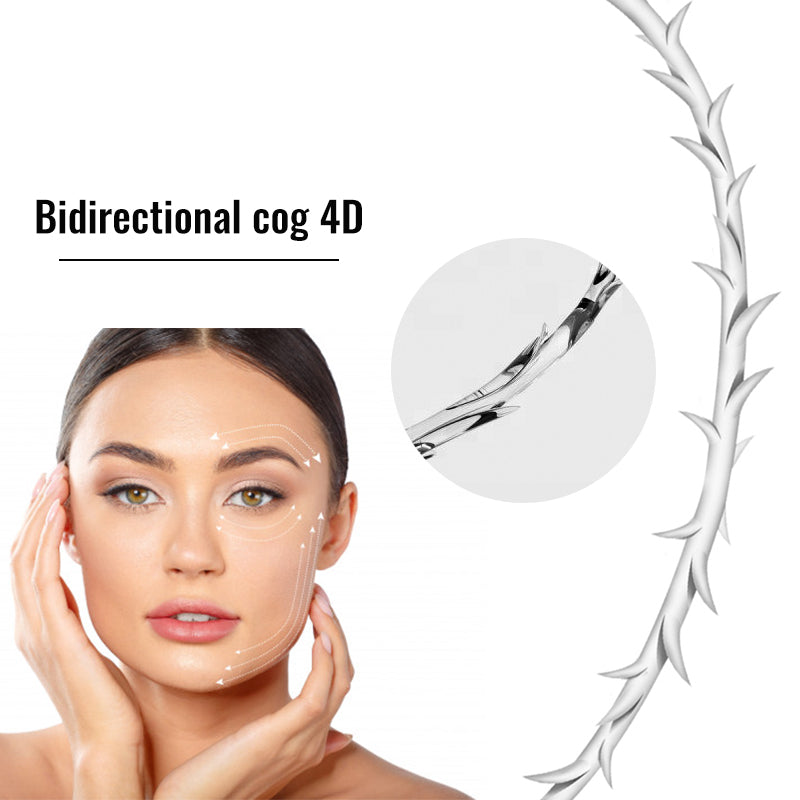
Auro PCL Bidirectional Cog 4D Threads 19G 21G Cannula
Auro PCL Bidirectional Cog 4D Threads 19G 21G Cannula
No se pudo cargar la disponibilidad de retiro
Auro PCL Bidirectional Cog 4D Threads — Ultra-Flexible 4-Quadrant Barbed Suture for Natural Dynamic Facial Elevation
Auro PCL Bidirectional Cog 4D Threads combine medical-grade Polycaprolactone (PCL) biopolymers with an advanced 4-quadrant bidirectional barb matrix. Engineered specifically for dynamic facial zones subject to frequent muscular movement (cheeks, smile lines, and jawline), the ultra-flexible PCL suture flexes naturally with facial expressions without causing rigid stiffness or pulling pain. Opposed bidirectional barbs create a secure self-locking anchor in the SMAS plane, delivering immediate mechanical lift and continuous collagen stimulation that lasts up to 2 years.
- Primary Function: Natural-looking mid-face and cheek elevation, dynamic expression zone lifting, jawline definition, and long-term tissue remodeling
- Bidirectional 4D Architecture: Dual-opposed micro-barbs arranged across 4 spatial planes (90° apart) for self-locking anti-migration tissue hold
- Ultra-Flexible PCL Polymer: High mechanical compliance that moves synchronously with facial muscles, eliminating post-op facial tightness
- Extended Longevity Profile: Gradual biological hydrolysis over 18–24 months; neocollagenesis framework sustains youthful contours for up to 24+ months
- Needle Delivery Systems: Atraumatic L-Cannula & W-Cannula (19G / 21G) for vascular-safe glide; Sharp Needle (19G / 21G) for precise anchor entry
- Suture Sizes: USP 2 heavy-duty flexible tensile filament
- Packaging: Double-sealed in sterile medical-grade blister foil pouches
Treatment Area & Protocol Selection Guide
The flexible dynamic compliance and self-locking grip of PCL Bidirectional Cog 4D make it the premier choice for expressive, high-movement facial vectors:
- Mid-Face & Malar Cheek Apex: 19G 100mm (L/W Cannula) (Recommended: 3–4 threads per side) — Lifts heavy descended cheek fat upward and outward, preserving completely natural smile dynamics.
- Jawline & Lower Cheek Definition: 19G 100mm or 21G 90mm (L/W Cannula) (Recommended: 3–5 threads per side) — Re-contours sagging jowls with smooth lateral tension that flexes with jaw opening.
- Nasolabial Fold Perimeter: 21G 90mm (L-Cannula) (Recommended: 2–4 threads per vector) — Relieves soft tissue overhang above the smile lines without creating a stiff appearance.
- Submental & Pre-Platysmal Sling: 19G 100mm (L-Cannula) (Recommended: 2–4 threads) — Tightens loose under-chin skin and flexes comfortably with swallowing and neck turning.
- Eyebrow Tail & Temporal Lift: 21G 90mm (L-Cannula or Sharp) (Recommended: 2–3 threads per side) — Provides flexible diagonal elevation to open lateral eye contours.


Quality, Safety & Sterility Assurance
- CE Certified Medical Device: Precision-manufactured under cleanroom standards, ensuring consistent tensile elasticity and tissue biocompatibility.
- 100% EO Gas Sterilized: Every blister pouch is individually treated with medical Ethylene Oxide (EO) gas for zero microbial contamination.
- 2-Year Sterile Shelf Life: Every pack is clearly stamped with a dedicated LOT number, manufacturing date, and 2-year expiration date.
- Protective Medical Aluminum Foil: High-barrier multi-layer foil pouches shield moisture-sensitive PCL polymers from ambient humidity and UV degradation during international transit.
- 100% Biocompatible Hydrolysis: PCL decomposes naturally into harmless carbon dioxide (CO2) and water (H2O), leaving zero synthetic residue or permanent foreign bodies.
FAQ
Q1: Why is PCL preferred over PDO for dynamic expression areas like the cheeks and smile vectors?
A: PDO is a stiffer polymer that can create noticeable tension or a "tight pulling" sensation when patients laugh or chew during the first few weeks. PCL (Polycaprolactone) has a significantly lower flexural modulus and higher elasticity. It bends and stretches synchronously with facial muscle contractions, providing structural lift without restricting natural facial mimicry or causing visible skin stiffness.
Q2: How does the "Bidirectional" barb design mechanically prevent thread migration?
A: In unidirectional cogs, all barbs face one direction, relying solely on distal tissue resistance to prevent slippage. Auro Bidirectional Cog 4D features opposed barbs on the two halves of the thread: the distal barbs grip and hoist fallen tissue, while the proximal barbs anchor into stable temporal/pre-auricular fascia. This creates a self-balancing, closed mechanical lock that prevents the suture from migrating forward or sliding backward under muscle shear.
Q3: Does the 2-year longevity of PCL mean the thread stays intact for 24 full months?
A: The solid PCL suture body undergoes slow, continuous bio-hydrolysis over 18 to 24 months. However, as it gradually dissolves, it continuously stimulates Type-1 and Type-3 neocollagenesis and angiogenesis along the entire thread tunnel. By the time the polymer is fully absorbed, a dense sheath of autologous collagen has replaced it, maintaining tissue lift and firmness for up to 2 years or longer.
Q4: What is the clinical benefit of using a 21G Cannula versus a 19G Cannula for PCL threads?
A:
• 21G (90mm): Ideal for patients with moderate skin laxity, thinner dermis, or when treating sensitive zones around the mouth and temporal region. It minimizes entry marks and creates virtually zero insertion trauma.
• 19G (100mm): Provides maximum tensile holding force and thicker PCL mass for patients with heavier fat pads, thicker skin, or pronounced jowl descent.
Q5: What should practitioners do if the patient experiences a mild "snapping" or "clicking" sound when chewing hard food on Day 3?
A: During the first 7–10 days, surrounding collagen encapsulation is still forming. If a patient bites down hard on tough food, a single barb might slightly slip through a fibrous septum, creating a harmless "click" sensation. Because the 4D barbs are distributed across 4 planes in bidirectional directions, adjacent barbs immediately maintain tension. Practitioners should advise patients to adhere to a soft-food diet for 10–14 days to allow the bilateral anchor to fully consolidate.