Auro PDO Cog 6D Lifting Threads 19G 100mm L and W Cannula
Auro PDO Cog 6D Lifting Threads 19G 100mm L and W Cannula
Couldn't load pickup availability
Auro PDO Cog 6D Threads — 360° Omnidirectional Barbed Suture for Heavy Structural Facial Elevation & Mandibular Sculpting
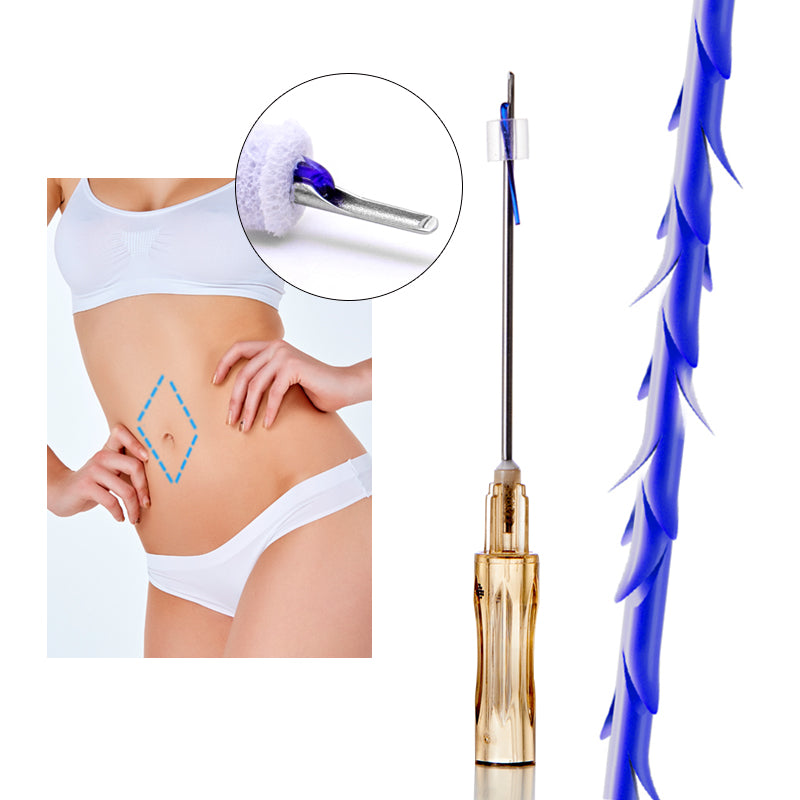
Auro PDO Cog 6D Threads are heavy-duty absorbable polydioxanone structural lifting sutures engineered with micro-barbs spirally positioned across 6 distinct spatial planes (60° radial spacing) around the entire 360-degree suture circumference. Designed specifically for severe tissue descent and heavy lower-face fat pads, this omnidirectional architecture distributes mechanical tension evenly in all dimensions, creating an interlocking grip in deep subcutaneous septa that prevents rotational thread slippage while stimulating vigorous Type-1 collagen synthesis.
- Primary Function: Heavy-duty tissue elevation, severe jowl restoration, crisp jawline contouring, mid-face malar repositioning, and submental sling suspension
- 360° Omnidirectional 6D Architecture: Continuous helical barbs across 6 geometric planes provide maximum pullout resistance and zero-slip tissue fixation
- Needle Delivery Systems: High-flow atraumatic 19G 100mm L-Cannula & W-Cannula engineered for vascular-safe gliding through dense subcutaneous planes
- Bio-Absorption Profile: 100% hydrolyzed via natural cellular metabolism over 6–8 months; rigid collagen matrix maintains firm structural support for 12–18 months
- Suture Sizes: USP-1 high-tensile structural barbed filament (160mm suture length)
- Packaging: Double-sealed in sterile medical-grade blister foil pouches
Treatment Area & Protocol Selection Guide
The 360° full-circumference grip and high tensile holding force of PDO Cog 6D are optimized for heavy tissue mass and high-tension lifting vectors:
- Severe Lower Face Jowls & Mandibular Border: 19G 100mm (L/W Cannula) (Recommended: 3–5 threads per side) — Anchors heavy, descended fat pads upward toward the pre-auricular and mastoid fascia.
- Mid-Face & Malar Cheek Fat Elevation: 19G 100mm (L/W Cannula) (Recommended: 3–4 threads per side) — Hoists flattened cheek volume obliquely to soften pronounced nasolabial folds.
- Heavy Fibrous Profiles & Male Patients: 19G 100mm (W-Cannula) (Recommended: 4–6 threads per side) — Penetrates dense, fibrous subcutaneous planes with superior stability against dynamic facial shearing.
- Submental Sling & Double Chin Tightening: 19G 100mm (L-Cannula) (Recommended: 2–4 threads) — Interlocking horizontal and oblique suspension to eliminate loose skin redundancy beneath the chin.
- Lateral Cheek & Pre-Auricular Tightening: 19G 100mm (L-Cannula) (Recommended: 2–3 threads per side) — Smooths accordion skin laxity along lateral facial borders toward deep temporal fixation.

Quality, Safety & Sterility Assurance
- CE Certified Medical Device: Precision-manufactured under cleanroom standards, ensuring strict tensile yield consistency and full tissue biocompatibility.
- 100% EO Gas Sterilized: Every blister pack undergoes pharmaceutical-grade Ethylene Oxide (EO) gas sterilization for zero bacterial or pyrogenic contamination.
- 2-Year Sterile Shelf Life: Every pack is clearly stamped with a dedicated LOT number, production date, and 2-year expiration date.
- Protective Medical Aluminum Foil: High-barrier multi-layer foil pouches shield sensitive PDO polymers from ambient humidity and UV degradation during international transit.
- 100% Biodegradable Hydrolysis: Ultra-pure polydioxanone hydrolyzes naturally into water and carbon dioxide with zero synthetic residue, nodules, or permanent foreign bodies.
FAQ
Q1: What mechanical advantage does Cog 6D provide over traditional Cog 4D or 3D threads?
A: In 3D (3 planes) and 4D (4 planes) configurations, there are unbarbed radial gaps where dynamic facial twisting can cause tissue to slide. Cog 6D arranges barbs across 6 distinct planes (every 60 degrees) around the full 360-degree perimeter. This omnidirectional distribution ensures that regardless of muscle contraction angle, multiple barbs are always engaged in deep fibrous septa, providing up to 40% higher resistance against rotational slippage in heavy jowl tissue.
Q2: When should I choose the W-Cannula over the L-Cannula for 19G Cog 6D placement?
A:
• W-Cannula (Wide-Bevel Blunt Tip): Features an optimized rounded leading edge with a wider lateral port. It is specifically engineered for navigating thick, dense, or fibrous subcutaneous tissue (such as male jawlines or revision cases) with significantly less pushing resistance and hand fatigue.
• L-Cannula (Standard Smooth Blunt Tip): The ideal choice for standard mid-face and jawline vectors where maximum vascular and nerve protection is desired in softer subcutaneous planes.
Q3: Because Cog 6D has barbs in 6 directions, how can practitioners avoid superficial skin puckering (dimpling)?
A: With 360° barbs, if the thread is inserted too superficially, upward-facing barbs can catch the reticular dermis. Cog 6D must be deployed strictly in the deep subcutaneous / pre-SMAS plane. If immediate skin dimpling occurs post-insertion, place sterile gauze over the dimple and perform a firm, sweeping manual stroke downward and backward along the vector before trimming the suture tail. This instantly disengages the superficial catch while leaving the deep fascia anchors locked.
Q4: What should patients expect regarding tightness and discomfort when opening the mouth during Week 1?
A: Because Cog 6D provides strong multi-plane mechanical suspension, patients will feel noticeable tightness along the jawline and temporal anchor when chewing or yawning during the first 5 to 7 days. This is completely normal and indicates robust structural fixation. Advise patients to eat soft foods and avoid wide yawning or dental work for 10 to 14 days; the sensation softens naturally as tissue integrates with the suture matrix.
Q5: What is the proper technique for trimming the USP-1 heavy structural thread tail?
A: Because the USP-1 suture core is relatively thick, leaving the cut tail near the dermis can lead to palpability or thread extrusion. Practitioners should press the skin inward around the entry point with forceps or a gauze pad while cutting the suture under slight tension. Once released, the cut tail will retract at least 4–5mm into deep adipose tissue, preventing any post-op surface protrusion.