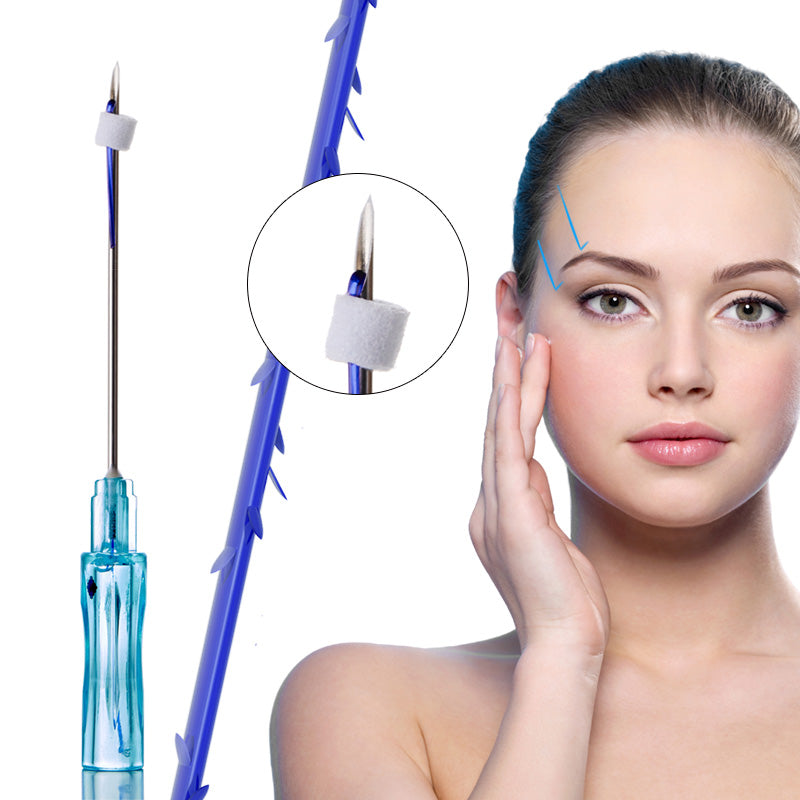
Auro PDO Cog 4D Lifting Threads 19G 21G L and W Cannula
Auro PDO Cog 4D Lifting Threads 19G 21G L and W Cannula
Couldn't load pickup availability
Auro PDO Cog 4D Lifting Threads — 360° Helical Barbed Structural Tissue Suspension
Auro PDO Cog 4D Lifting Threads are heavy-duty absorbable polydioxanone suspension sutures engineered for immediate mechanical tissue repositioning, mid-face contouring, and jawline definition. Built with high-tensile USP 2 surgical-grade PDO sutures and an advanced 360° helical barb array, each thread anchors subcutaneous tissue across four radial directions simultaneously, distributing lifting tension evenly without localized dimpling, puckering, or rotational slippage.
- Primary Function: Immediate structural tissue elevation, jowl repositioning, malar fat pad suspension, and temporal Fox Eye lift
- Needle Delivery Systems: Available in S (Sharp Needle), L (Long Blunt Cannula), and W (Wide-Lumen Blunt Cannula)
- Barb Architecture: 360° spiral 4-directional cutting barbs for omnidirectional anchor strength
- Absorption Profile: 100% hydrolyzed via natural biological breakdown over 6–8 months; structural collagen scaffold maintains lifted contour for 12–18 months
- Suture Sizes: USP 2 heavy-duty high-tensile barbed filament
- Packaging: Sealed in sterile medical-grade blister foil pouches
Treatment Area & Needle System Selection Guide
Selecting the appropriate needle type and gauge is critical for optimizing vector lift and minimizing patient downtime:
1. Needle Delivery System Selection (S vs. L vs. W):
- L-Cannula (Blunt Long - 19G/21G): Rounded atraumatic tip glides through subcutaneous tissue planes without cutting nerves or blood vessels. Ideal for mid-face, cheeks, and delicate vascular corridors to virtually eliminate bruising.
- W-Cannula (Blunt Wide - 19G/21G): Expanded inner lumen prevents barb compression during insertion in dense, fibrous fat layers. Essential for heavy lower-face jowls and submental neck tightening.
- S-Needle (Sharp - 19G/23G): Beveled sharp surgical needle for direct single-step placement without requiring a pilot needle pre-puncture. Preferred by experienced practitioners for high-precision temporal anchoring.
2. Clinical Vector & Protocol Guide:
- Jawline & Lower Face Jowls: 19G 100mm (L or W Cannula) (Recommended: 3–5 threads per side) — Anchors deep subcutaneous tissue along the mandibular border to restore a sharp, defined jawline.
- Mid-Face & Cheek Elevation: 19G or 21G 100mm (L-Cannula) (Recommended: 3–4 threads per side) — Repositions descended malar fat pads and softens deep nasolabial folds through true structural lifting.
- Fox Eye & Temporal Brow Lift: 21G or 23G 60mm/90mm (S-Needle or L-Cannula) (Recommended: 2–3 threads per side) — Oblique vector lift from lateral orbital rim toward temporal fascia for elevated outer brow contours.
- Submental & Double Chin Tightening: 21G 90mm or 19G 100mm (W-Cannula) (Recommended: 2–4 threads) — Creates a supportive hammock under the chin, tightening submandibular laxity.

Quality, Safety & Sterility Assurance
- CE Certified Medical Device: Manufactured under strict international medical standards for verified tensile holding force and clinical safety.
- 100% EO Gas Sterilized: Every individual blister pack undergoes rigorous Ethylene Oxide (EO) sterilization, ensuring zero contamination.
- 2-Year Sterile Shelf Life: Every pack is clearly stamped with a dedicated LOT number, production date, and 2-year expiration date.
- Protective Medical Aluminum Foil: Double-sealed sterile pouches prevent polymer degradation from ambient humidity, UV light, and heat during international transit.
- Biocompatible & Non-Pyrogenic: Ultra-pure absorbable suture polymer that fully hydrolyzes into water and carbon dioxide with zero residue, granuloma, or pigment accumulation.
FAQ
Q1: Why is a 360° 4D helical barb configuration superior to standard 2D bidirectional cog threads?
A: Standard 2D cog threads feature barbs cut along only two opposing flat planes, providing traction in a single linear axis and leaving the thread vulnerable to rotational slippage when facial muscles contract. The Cog 4D arranges precision barbs in a continuous 360° spiral across four angular quadrants. When tensioned, tissue is gripped from every radial direction simultaneously, distributing mechanical stress evenly across the full thread length and significantly reducing the risk of barb disengagement or localized skin puckering.
Q2: How do I avoid skin dimpling (puckering) or thread visibility during Cog 4D placement?
A: Skin dimpling is almost always caused by inserting threads too superficially into the upper dermis or failing to release tension before needle withdrawal. Cog 4D threads must be placed strictly in the subcutaneous fat layer (hypodermis) immediately above the SMAS layer. Ensure smooth, gentle retrograde massage along the treatment vector after cannula withdrawal to allow surrounding fat tissue to drape evenly over the barbs.
Q3: When should I choose 19G versus 21G or 23G Cog 4D threads?
A:
• 19G (Heavy-Duty Lift): Thicker suture core with maximum tensile holding capacity. Best for heavy facial tissue, severe jowl descent, and thick male skin.
• 21G (Standard Mid-Face Lift): Balanced tensile strength and thin insertion profile. The primary choice for cheeks, malar fat pads, and moderate laxity.
• 23G (Refined / Delicate Lift): Thinner gauge designed for lower-resistance placement in thinner skin, temporal brow lifting, and refined vector corrections.
Q4: What is the recovery timeline, and what should patients expect in the first 72 hours?
A: Mild localized soreness, minor swelling along the entry points, and an initial tight pulling sensation are standard signs of effective mechanical fixation that typically resolve within 3 to 7 days. Patients should avoid wide jaw opening (excessive chewing, dental work), facial massage, high-intensity exercise, and sleeping on their sides for 10–14 days post-procedure to ensure undisturbed tissue anchoring.
Q5: Can Cog 4D threads be combined with Mono threads or Dermal Fillers?
A: Yes. In comprehensive full-face protocols, Cog 4D threads are placed first to structurally elevate and reposition descended fat pads. Smooth Mono threads can then be placed in a superficial cross-hatch pattern to improve skin texture and elasticity, followed by minimal hyaluronic acid filler to address residual localized hollows.