Auro PDO-Faden zum Formen – Starke Lifting-Wirkung für Gesicht und Körper
Auro PDO-Faden zum Formen – Starke Lifting-Wirkung für Gesicht und Körper
Verfügbarkeit für Abholungen konnte nicht geladen werden
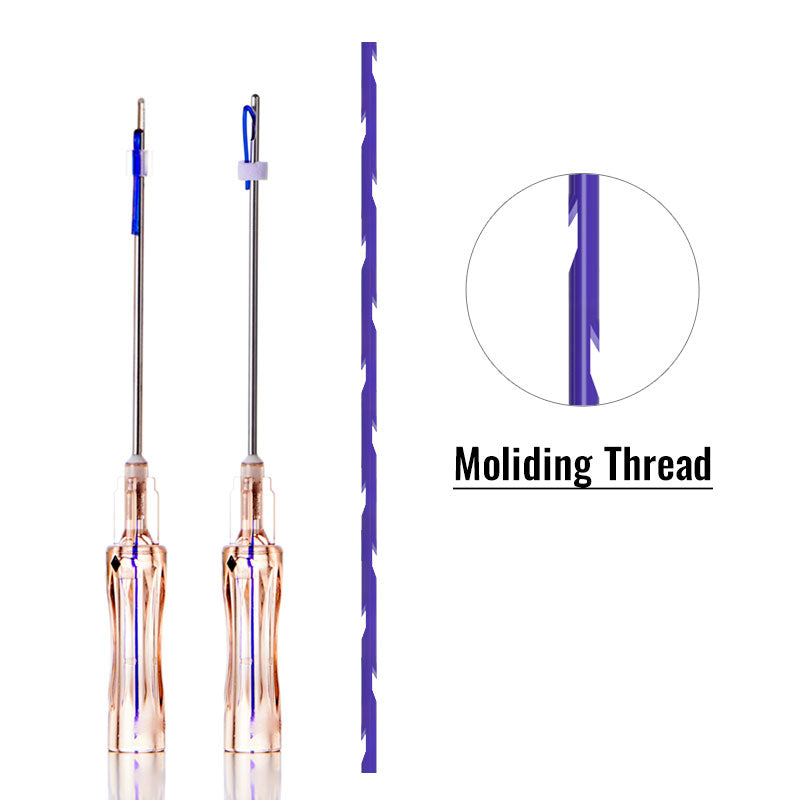
Auro PDO Molding Cog Threads — 3rd Gen Cold-Pressed Monolithic Barbs for Maximum Structural Lifting & Body Contouring
Auro PDO Molding Cog Threads represent the gold standard in heavy-duty structural suspension. Unlike traditional cutting cogs that slice into the suture core and compromise tensile strength, our 3rd-generation cold-press molding process shapes monolithic, solid barbs without thermal degradation. This preserves 100% of the USP 2 suture core integrity, delivering unparalleled tensile strength and anchor holding force for severe facial descent, heavy fibrous skin, and body tightening.
- Primary Function: High-load tissue hoisting, severe lower-face jowl restoration, sharp mandibular border sculpting, and body contour tightening (abdomen, buttocks, upper arms)
- Monolithic Molding Technology: Solid pressed barbs with uncompromised core diameter, eliminating barb peel-back and thread breakage
- Needle Delivery Systems: 18G / 19G L-Cannula & W-Cannula for smooth gliding through dense subcutaneous planes; 19G Sharp Needle for fibrous anchor points
- Bio-Absorption Profile: 100% hydrolyzed into safe biological metabolites over 6–8 months; rigid collagen matrix maintains firm suspension for 12–18 months
- Suture Sizes: USP 2 heavy-duty high-tensile molded filament
- Packaging: Double-sealed in sterile medical-grade blister foil pouches
Treatment Area & Protocol Selection Guide
Engineered for vectors carrying significant gravitational weight or dense fibrous tissue resistance:
- Severe Lower Face Jowls & Mandibular Border: 18G or 19G 100mm (L/W Cannula) (Recommended: 4–6 threads per side) — Strongest mechanical hoist to reposition heavy descended fat pads along the jawline.
- Mid-Face Deep Malar Fat Pad Elevation: 19G 100mm (L/W Cannula) (Recommended: 3–4 threads per side) — Re-anchors fallen mid-cheek volume upward toward the zygomatic arch to alleviate deep nasolabial folds.
- Heavy Fibrous Skin & Male Patient Lifting: 18G 100mm (W-Cannula) (Recommended: 4–6 threads per side) — Delivers the maximum shear resistance needed for thick, dense male facial planes.
- Submental Sling & Double Chin Tightening: 19G 100mm (L-Cannula) (Recommended: 2–4 threads) — Interlocking suspension to flatten under-chin skin and platysmal laxity.
- Body Contouring (Abdomen, Buttocks, Upper Arms): 18G or 19G 100mm (L/W Cannula) (Recommended: 6–12 threads per zone) — Provides the heavy tensile capacity required to lift lax body skin.

Quality, Safety & Sterility Assurance
- CE Certified Medical Device: Precision-manufactured under strict cleanroom conditions, ensuring verified high tensile yield strength and clinical safety.
- 100% EO Gas Sterilized: Every blister pack undergoes pharmaceutical-grade Ethylene Oxide (EO) sterilization, ensuring zero microbial contamination.
- 2-Year Sterile Shelf Life: Every pouch is stamped with a dedicated LOT number, production date, and 2-year expiration date.
- Protective Medical Aluminum Foil: Multi-layer moisture-proof foil packaging prevents polymer degradation from ambient humidity and UV exposure during international transit.
- Biocompatible Hydrolysis: Ultra-pure polydioxanone hydrolyzes naturally into water and carbon dioxide with zero synthetic residue or granuloma risk.
FAQ
Q1: Why do traditional cut cogs frequently snap or lose tension after 2–3 weeks, and how does Molding prevent this?
A: Traditional cogs are made by cutting notches into a smooth suture, which permanently reduces the core diameter by 30%–50% at every cut and creates weak stress points prone to snapping. Furthermore, cut barbs easily fold flat ("peel off") under the weight of heavy tissue. Auro Molding Threads are manufactured by compressing pure PDO in solid steel molds without cutting or heat. The barbs are solid, integrated monolithic structures that preserve 100% of the thick USP 2 core, maintaining sustained high-tension grip without breakage or barb collapse.
Q2: Because Molding threads are thick (USP 2 / 18G), will the patient feel hard cords or foreign bodies when chewing or talking?
A: When placed strictly in the correct anatomical plane—the deep subcutaneous layer just above the SMAS—the thick molded suture is cushioned by surrounding deep adipose tissue and cannot be felt or seen. If a patient feels a distinct "tight cord" when opening their mouth during the first 7–10 days, it is simply initial tissue anchoring against dynamic muscle movement. As the surrounding tissue softens and collagen encapsulation begins, this sensation completely disappears within 2 weeks.
Q3: Can Auro PDO Molding Cog actually lift heavy body areas like postpartum abdominal skin or upper arms?
A: Yes. Most facial threads fail on the body because body skin is thicker and subject to continuous heavy muscle shearing. The ultra-high tensile yield strength of Auro 18G/19G Molding threads provides the rigid structural scaffolding required to gather and hoist loose abdominal laxity, tighten upper arm "bat wings," and elevate lower gluteal folds where standard cut threads would instantly snap.
Q4: What is the practical handling difference between the W-Cannula and L-Cannula in dense or male skin?
A: In dense, fibrotic tissue (such as male jawlines or scarred subcutaneous planes), standard L-cannulas can encounter high push resistance. The W-Cannula features a specially engineered wide-angle bevel at its blunt tip that parts tough fibrous septa with significantly less operator hand fatigue and zero risk of slicing blood vessels, allowing smooth, continuous vector advancement.
Q5: If aggressive tissue hoisting causes immediate skin puckering or dimpling, how is it corrected?
A: Due to the extreme grip of molded barbs, localized dimpling can happen if a barb catches superficial dermis. To fix this instantly before cutting the suture: place your thumb over the dimple and perform a firm, sweeping downward-and-outward manual stroke along the vector. This disengages the single superficial barb from the upper dermis while leaving the deeper structural anchors intact, restoring a smooth, flat skin contour immediately.