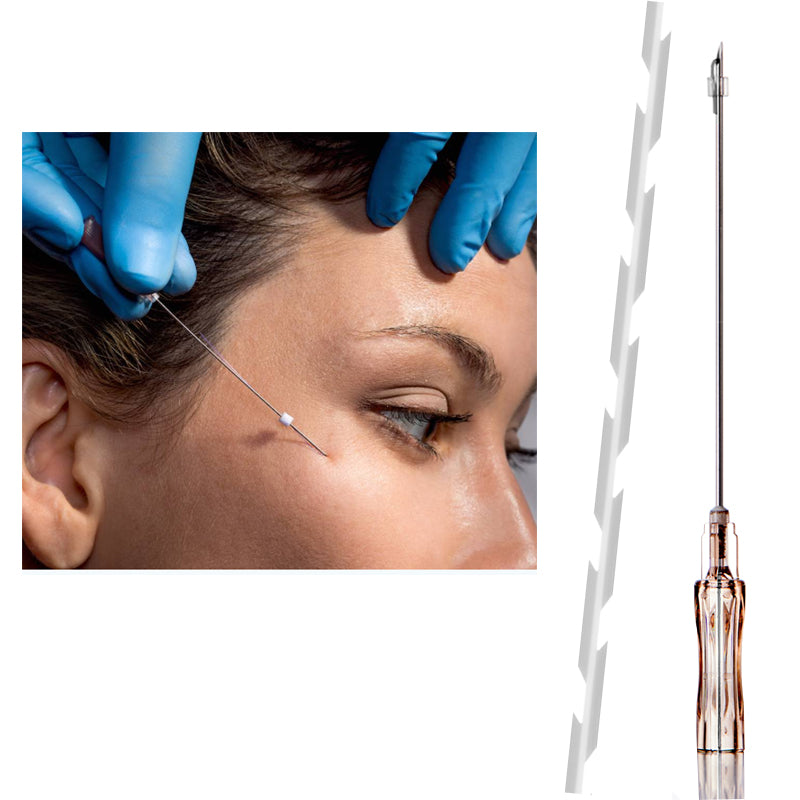
Auro PCL Molding Cog Threads 19G 100mm L and W Cannula
Auro PCL Molding Cog Threads 19G 100mm L and W Cannula
Verfügbarkeit für Abholungen konnte nicht geladen werden
Auro PCL Molding Cog Threads — Ultra-Tensile Solid-Molded Barbs for 2-Year Natural Dynamic Facial Elevation
Auro PCL Molding Cog Threads combine non-cut, pressure-molded anchoring barbs with ultra-flexible medical-grade Polycaprolactone (PCL). Unlike traditional cut cog threads that weaken the suture core, our molding process forms solid, reinforced barbs directly onto an uncut high-tensile core, delivering unmatched load-bearing anchorage for heavy, descended tissues. Engineered with PCL’s superior viscoelasticity, the suture flexes dynamically with natural facial animation without stiff foreign-body sensation, stimulating continuous collagen and elastin regeneration for over 24 months.
- Primary Function: Heavy lower-face jowl elevation, thick fibrous tissue repositioning, deep mid-face suspension, and long-term mandibular recontouring
- Non-Cut Molding Architecture: Press-molded solid barbs with an intact suture core providing maximum tensile resistance against barb snapping and slippage
- PCL Dynamic Biocompatibility: Highly flexible polymer that adapts seamlessly to facial mimicry, preventing restricted facial expressions and palpability
- 2-Year Extended Longevity: Resorbs slowly via ester hydrolysis over 24–36 months; sustained matrix stimulation preserves natural youthfulness for 2+ years
- Suture Sizes: Heavy-duty high-tensile PCL monofilament (USP 1 / USP 2 / USP 1-0)
- Cannula Delivery System: 19G & 21G (100mm) L-Cannula and W-Cannula engineered for atraumatic deep gliding through dense fibrotic planes
- Packaging: Double-sealed in sterile medical-grade blister foil pouches (10 pcs or 20 pcs/pack)
Treatment Area & Protocol Selection Guide
The massive mechanical anchoring power and dynamic pliability of PCL Molding Cog threads are indicated for areas requiring heavy structural repositioning without compromising natural movement:
- Heavy Lower-Face Jowls & Pre-Jowl Deficits: 19G 100mm W or L-Cannula (Recommended: 3–5 threads per side) — Anchors dense subcutaneous fat pads firmly upward to restore a clean, youthful jawline angle.
- Descended Malar Fat Pads & Mid-Face Ptosis: 19G 100mm or 21G 100mm L-Cannula (Recommended: 3–4 threads per side) — Re-suspends heavy mid-cheek tissue to instantly flatten deep nasolabial folds from above.
- Submental Laxity & Double Chin Definition: 21G 100mm L-Cannula (Recommended: 2–4 threads placed in a deep suspension sling) — Tightens heavy submental soft tissue and sharpens the cervicomental transition.
- Thick, Fibrous Male Patient Facial Architecture: 19G 100mm W-Cannula (Recommended: 4–6 threads per side) — Delivers the extreme structural tensile strength necessary to elevate thick, heavy male skin without suture breakage.
- Lateral Cheek & Sub-SMAS Deep Vector Tightening: 19G 100mm (Recommended: 2–3 threads per side) — Provides strong lateral fixation into the deep temporal and pre-auricular fascia.

Quality, Safety & Sterility Assurance
- CE Certified Medical Device: Precision-manufactured under ISO-compliant cleanroom conditions, ensuring microscopic molding consistency and verified tensile uniformity.
- 100% EO Gas Sterilization: Individually sterilized with medical Ethylene Oxide (EO) gas, thoroughly eliminating all bio-burden while preserving PCL polymer elasticity.
- 2-Year Sterile Shelf Life: Clearly labeled with verifiable LOT numbers, sterilization tracking, and a validated 2-year expiration shelf life.
- Heavy-Duty Moisture-Proof Foil: Vacuum-sealed inside multi-layer aluminum blister pouches to guard against ambient humidity, temperature shifts, and polymer degradation during global transit.
- 100% Biocompatible Degradation: Polycaprolactone breaks down safely into non-toxic biological metabolites (caproic acid, water, and CO2) with zero permanent residue or chronic granuloma formation.
FAQ
Q1: Why is Molding Cog technology superior to traditional cut cog threads for heavy sagging?
A: Traditional cut threads (such as Cog 3D/4D) are manufactured by slicing into the suture shaft with micro-blades, which reduces the effective core diameter by 30–40% and creates weak notch points prone to snapping under heavy tissue weight. Auro Molding Cog utilizes a high-pressure molding die that forms thick, solid barbs onto an intact central core. This uncompromised core diameter provides 3 to 4 times higher tensile load capacity, completely eliminating barb peel-off or thread snapping during vigorous tissue elevation.
Q2: Thick sutures (USP 1 / USP 2) often feel stiff—how does PCL solve the foreign body sensation?
A: High-gauge PDO threads can feel rigid and restrict natural smiling during the first several weeks. PCL is inherently viscoelastic with a significantly lower elastic modulus, making it soft, supple, and bendable. Despite its heavy USP 1/2 gauge and immense lifting strength, PCL Molding Cog flexes naturally with smiling, chewing, and speaking, ensuring zero tightness, zero visible cord-like stiffness, and total patient comfort.
Q3: When should practitioners choose W-Cannula vs. L-Cannula for 19G Molding threads?
A:
• W-Cannula (Blunt with dual-side opening / bullet tip): Best suited for dense, fibrotic, or previously treated tissue (e.g., male patients or scar tissue planes). The smooth, tapered tip parts tough fibrous septa effortlessly without deviating off-plane.
• L-Cannula (Semi-blunt side port): Ideal for standard deep subcutaneous gliding along the zygomatic and mandibular vectors, providing superior tactile feedback and precise level control just above the SMAS layer.
Q4: What causes early thread slippage, and how does PCL Molding Cog prevent it?
A: Early slippage usually occurs when thin cut barbs collapse or bend backward under tissue tension. Auro Molding Cog features solid, pyramid-shaped barbs with reinforced structural bases that cannot fold down. Once engaged in the sub-dermal adipose septa, the barbs lock permanently into tissue architecture, maintaining initial mechanical elevation until natural collagen consolidation takes over.
Q5: Why does PCL provide a 2+ year result compared to 8–12 months for PDO?
A: PDO hydrolyzes rapidly within 6–8 months, leaving collagen that gradually softens by month 12. PCL has long, hydrophobic aliphatic chains that hydrolyze very slowly over 24 to 36 months. Throughout this extended timeline, the PCL scaffold continuously stimulates fibroblasts to produce both Type I/III collagen and elastin fibers, ensuring structural firmness and skin elasticity that last well past 2 years.